Technology related topic like electrons,electronics devices,material,component,wireless communication and technology

Showing posts with label Electronics. Show all posts

Sunday, November 29, 2020

Transformer


 Transformer 


Transformer 

A Transformer may be a static electrical machine which transfers AC wattage from one circuit to the alternative circuit at the constant frequency, but the voltage level is altered meaning voltage is also increased or decreased in step with the requirement.


transformers, transformer diagram, transformer all part, transformer ac to dc, transformer breather, transformer burst, transformer details, transformer definition physics, transformer device, transformer efficiency

It works on the principle of Faraday’s  Electromagnetic Induction Law which states that “ the magnitude of voltage is directly proportional to the speed of change of flux.”

Types of Transformer

The various types are described below-

1. According to the transformation ratio or number of turns within the windings

  • Step up
  • Step down

2. Position of the windings concerning the core

  • Core type
  • Shell type

3. On the concept of the provision

  • Single-phase
  • Three-phase

4. types of services

  • Power transformer
  • Distribution transformer
  • Instrument transformer
  • Current transformer
  • Potential transformer
  • Auto-transformer

5. On the premise of cooling

  • Air Natural (AN) or dry type
  • Air ForceD (AF) or Air Blast type
  • Oil Natural Air Natural (ONAN)
  • Oil Natural Air Forced (ONAF)
  • Oil Forced Air Forced (OFAF)
  • Oil Natural Water Forced (ONWF)

Transformer parts

Core

The core of the transformer is utilized to support the windings. it's fabricated from soft iron to cut back eddy current loss and Hysteresis loss, and provides low reluctance path to the flow of magnetic flux. The diameter of a transformer’s core is  inversely proportional to iron loss and directly proportional to copper loss .

Windings

Windings accommodates several copper coil turns bundled together, each bundle connected to form a full winding. Windings could also be based either on the input-output supply or on the voltage range. Windings that are supported supply are classified into primary and secondary windings. On the alternative hand, windings supported voltage range are often classified into high voltage and low voltage windings.

Transformer oil

The transformer oil insulates similarly as cools the core and coil assembly. The core and windings of the transformer must be completely immersed within the oil that normally contains hydrocarbon mineral oils.

Insulating materials

Insulating materials like papers and card boards are accustomed isolate primary and secondary windings from one another additionally because the transformer core. These windings are manufactured from copper because of high conductivity and ductility. High conductivity minimizes the number of copper needed and minimizes losses. Moreover, high ductility lands up in easy bending of conductors into tight winding around the core that also minimizes the amount of copper and volume of winding.

Conservator

The conservator is an airtight metallic cylindrical drum . It fitted above the transformer. It conserves the transformer oil. it's vented at the best and is filled only half with the oil to allow expansion and contraction during temperature variations of transformer oil tank. However the foremost tank of the transformer with which the conservator is connected is completely full of the oil through a pipeline.

Breather

The breather might be a cylindrical container filled with colloid, which is used to remain the air that enters the tank moisture-free. this could be because the insulating oil when reacts with moisture can affect the insulation and cause internal faults, which is why it is a requirement to remain the air free from moisture. within the breather, when the air passes through the colloid, the moisture contents are absorbed by the silica crystals.

Buchholz Relay

Placed over the connecting pipe that runs from the foremost tank to conservator tank the Buchholz Relay senses the faults occurring within the transformer. It operates by the gases emitted because of decomposition of transformer oil during internal faults. Thus, this device is employed to sense and successively protect the transformer from internal faults.

Tap changer

Tap changer is use to balance voltage variations within the transformer. There are two styles of tap changers – on load and off load. In on load tap changers, tapping is modified without isolating transformer from the availability, while in off load, the transformer has got to be disconnected from the supply.

Cooling tubes

As the name suggests, cooling tubes are accustomed cool the transformer oil. The circulation of oil within the transformer could even be natural or forced. within the case of natural circulation, when the oil temperature rises, the recent oil naturally moves to the very best and cold oil moves down, while just just in case of forced circulation, never-ending pump is used.

Explosion vent

The boiling oil or oil from the transformer is expelled during internal faults through the explosion vent to avoid explosion of the transformer.This is often often generally placed above the quantity of the conservatory tank.

Losses in Transformer 

  • Core or iron losses
  • Hysteresis loss
  • Eddy current loss
  • Copper losses
  • Stray losses

Transformer Efficiency

Transformer efficiency is defined because the ratio of the output power to the input power and is expressed within the equation below

Efficiency = output power / input power


Read more>> WLAN

                         Bluetooth Technology

                         Bipolar junction transistor

                         FET

                         Flip Flop

                         Op-amp

                         Programming model 

                            Power amplifier

                            Capacitor

                            TRANSISTOR

                            Mobile communication

                            Communication System


Friday, November 27, 2020

Communication system


       Communication system


Communication

Communication is that the process of transfer of data from sender to receiver.The transmitter converts the knowledge into signals suitable for the channel . 

Communication system
Fig. Communication system
              

While the signals propagate through the channel , noise signals (unwanted signal) arise. These signals along side noise will reach the receiver end, where message signal is filtered from the transmitted signal along side noise. 

To some extent, the noise signals are often filtered out and therefore the message signal are often reproduced.

Basically there are three elements in comm-unication system-
  1. Transmitter
  2. Communication channel
  3. Receiver

1.Transmitter Unit

                                      The information can't be transmitted in its raw format through the channel. Transmitter unit is used to convert raw information into the format that's understandable by the channel . Different methods like modulation and coding could even be used hoping on the requirement . Mobile phones and AM radio transmitters are variety of the foremost familiar transmitters. Modulation is employed to superimpose a coffee frequency message signal on to a high frequency carrier to protect the signal from getting dispersed.

2.Communication channel

                                      Communication channel is defined because the medium through which the signal is send from transmitter to receiver. When signal is propagated through the channel, it gets suffering from noise. And channel attenuation degrades the signal strength, so signal power decreas with distance. In radio communication systems, air is that the medium and in satellite communication systems, both air and vacuum are the medium.

3.Receiver

                    Signals sent through the channel reaches the receiver, where it's decoded or demodulated to extract the message. Since channel attenuation degrades the signal power, amplifier is employed at the receiver to catch up on the transmission losses. Both selectivity and sensitivity of a receiver should be high only then the message signal are often extracted from the received signal.

Communication System Termino-logy

1.Signal

                 Any audio or video or audio-visual generated for instance can't be directly transmitted. It first must be converted into an electronic form. This electronic form is a ‘Signal’. Since electronics operate in the binary system i.e. a combination of 1s and 0s only (generally 1 denotes ‘on’ or ‘high’ and 0 denotes ‘off’ or ‘low’), the whole audio-visual is converted into a binary form. This binary form within the electrical medium may be a ‘Signal’.

2. Amplitude

                     The greatest distance that a wave, especially a sound or radio emission , moves up and down.

3.Wavelength

                         The wavelength of a sinusoi-dal wave is that the distance between two particles having an equivalent amount of displacement and both are in phase with one another .

4.Frequency

                       The frequency of a wave is that the number of waves passing some extent in space per unit time. It is basically the reciprocal of the period of time required by a wave to hide a unit distance.

5. Bandwidth

                        The bandwidth of a sign is that the difference between the very best and therefore the lowest frequencies carried by the signal.

6.Modulation

                  Any signal to be transmitted consists of variety of varying frequencies and can't be directly transmitted by the transmitter and is therefore superimposed with a carrier signal before being transmitted. This is the ‘Modulation’ of the signal.

Modulation of the signal is in two ways.
  • Amplitude Modulation
  • Frequency Modulation
  • Phase Modulation

7.Demodulation

                                The modulated signal sent by the transmitter is received by the receiver and wishes to be converted to its original format before it are often studied. This process is Demodulation. It is basically the reverse of Modulation.

8. Attenuation

                   When a sign is transmitted through the electronic medium over long distances it loses its quality and strength thanks to dissipation and wastage of energy naturally. This is the ‘attenuation’ of the signal. Using the various methods we prevent or minimize the deterioration of the signal.

9. Transducer

                         A transducer is any device that converts any physical variable like force, movement etc to an signal and thus gives an appropriate output for an equivalent . 

For example, whenever you employ your smartphone and choose a worth on its screen the processor of the phone converts the pressure on the screen thanks to your touch into a signal. This is an example of a ‘Transducer’.

10. Amplification

                                The process of boosting the amplitude of a signal is “amplification”. 
For example, whenever you speak on a mic, your voice is amplified and audible at a farther distance. 

In this process, only the amplitude of the signal increases. There is no fundamental change to the first content of the signal.

11. Repeater

                       Any signal transmitting over an extended distance is liable to lose its quality and strength. 
To beat this issue we use a “repeater” to facilitate transmission of the signal over very long distances.


Read more>> WLAN

                         Bluetooth Technology

                         Bipolar junction transistor

                         FET

                         Flip Flop

                         Op-amp

                         Programming model 

                            Power amplifier

                            Capacitor

                            TRANSISTOR

                            Mobile communication


Saturday, November 21, 2020

Mobile communication


                Mobile communication


Mobile communication is the utilization of innovation that permits us to speak with others in various areas without the utilization of any actual association (wire or link). Mobile communication makes our life simpler, and it spares time and exertion. 

A mobile telephone (likewise called mobile cell organization, PDA or hand telephone) is a case of mobile communication (remote communication). 


Mobile communication,mobile,mobile phone,GSM,4g,5g

It is an electric gadget utilized for full-duplex two-way radio telecommunications on a cell organization of base stations known as cell locales. 


GSM (Global system for Mobile communication)

GSM represents Global System for Mobile Communications. GSM is one of the most broadly utilized advanced remote communication frameworks. 

It was created in Europe during the 1980s and is presently the global norm in Europe, Australia, Asia and Africa. Any GSM handset with a SIM (Subscriber Identity Module) card can be utilized in any nation that utilizes this norm. 

Each SIM card has an exceptional ID number. It has memory for putting away applications and information, for example, telephone numbers, memory for sending and getting its capacities and programming to the processor. 

                              GSM innovation utilizes TDMA (Time Division Multiple Access) to help up to eight calls at the same time. It likewise utilizes encryption to make information safer. 

The frequencies utilized by the worldwide standard are 900 MHz to 1800 MHz. Notwithstanding, GSM telephones utilized in the US utilize the 1900 MHz recurrence and are along these lines not viable with the global framework. 


Mobile communication,mobile tower,gsm tower,mobile,mobile phone,GSM,4g,5g

CDMA (Code Division Multiple Access)

CDMA code division is for various access. It was first utilized by the British Army during World War II. After the war, its utilization spread to non military personnel regions because of high help quality. 

As each client gets the whole range consistently, the voice quality is high. Furthermore, it is consequently scrambled and hence gives high assurance against signal hindering and snoopping. 


GPRS (General Packet Radio Service)

GPRS represents General Packet Radio Services. It is a bundle based remote communication innovation that charges clients dependent on the measure of information they send rather than the time-frame for which they are utilizing the administration. 

                              This is conceivable in light of the fact that GPRS sends information to the organization in parcels and its throughput relies upon network traffic. As traffic builds, administration quality can diminish because of blockage, so it is coherent to charge clients as indicated by information volume. 

GPRS is the mobile communication convention utilized continuously (2G) and third era (3G) of mobile communication. It guarantees speeds from 56 Kbps to 114 Kbps, albeit real speeds may shift contingent upon network load. 


1G - First Generation

It was the original of phone innovation. The original of business cell networks were set up in the last part of the 70s to 80s with completely appropriate guidelines. It was presented by Telecom (today known as Telstra) in 1987, Australia obtained its first cell mobile telephone network utilizing a 1G simple framework. 

1G is a simple innovation and the telephone normally had helpless battery life and the voice quality was huge absent a lot of security, and would infrequently encounter dropped calls.

These are simple telecommunications guidelines that were presented during the 1980s and proceeded until supplanted by 2G advanced telecommunications. The greatest speed of 1G is 2.4 Kbps. 


2G - Second Generation

The mobile phone got its first significant update while going from 1G to 2G. The fundamental target of this age was to give secure and dependable communication channels. 

It actualized the idea of CDMA and GSM. Given little information administration like SMS and MMS. The second era 2G cell telecommunications network was monetarily dispatched in 1991 by Radiolinja (presently part of Elisa Oyaz) on the GSM standard in Finland. 

2G abilities are accomplished by permitting numerous clients on a solitary channel through multiplexing. Phones are utilized for voice just as information during 2G. Advances in innovation from 1G to 2G presented various essential administrations that we actually use today, for example, in light of SMS, inside wandering, telephone calls, call hold and charging administrations for example Charges dependent on significant distance calls and constant charging.Before the significant jump forward for 2G to 3G remote organizations, the lesser-realized 2.5G and 2.75G was a break standard that overcame any barrier. 


3G - Third Generation

This age has set principles for most remote innovation that we know and love. The third era presented web perusing, email, video downloading, picture sharing and other cell phone innovation. Presented financially in 2001, the expressed objective for third-age mobile communications was to encourage more noteworthy voice and information limit, uphold a more extensive scope of utilizations, and upgrade information transmission at a lower cost. 

The 3G standard uses another innovation called UMTS as its center organization design - the all inclusive mobile telecommunications framework. This organization joins parts of 2G networks with some new innovation and conventions to give altogether quicker information rates. 

In view of a bunch of principles utilized by the International Telecommunications Union for mobile gadgets and mobile telecommunications use administrations and organizations agreeing to the International Mobile Telecommunications-2000 (IMT-2000) particulars. One of the necessities set by IMT-2000 was that the speed must be at any rate 200Kbps to call it as a 3G administration. 

Backing for real time just as sight and sound administrations in 3G is more famous. In 3G, widespread access and conveyability is conceivable across various gadget types (phone, PDA, and so forth) 3G improved the proficiency of the recurrence range by improving how sound is packed during a call, so there might be more concurrent brings in a similar recurrence range. 

The International Telecommunication Union IMT-2000 norm of the United Nations requires a fixed speed of 2Mbps for "valid" 3G and a mobile speed of 384kbps. The hypothetical greatest speed for HSPA + is 21.6 Mbps. 

Like 2G, 3G developed into 3.5G and 3.75G as more highlights were acquainted with achieve 4G. A 3G telephone can't convey through a 4G network, yet new ages of telephones are basically consistently intended to be in reverse viable, so a 4G telephone can impart through 3G or 2G organizations Could .. 


4G - Fourth Generation

4G is an altogether different innovation than 3G and was made basically conceivable because of the headway in innovation over the most recent 10 years. 

It means to furnish clients with rapid, high caliber and high limit while improving security and lessening the expense of voice and information administrations, sight and sound and Internet over IP. Potential and current applications incorporate changed mobile web access, IP communication, gaming administrations, superior quality mobile TV, video conferencing, 3D TV, and distributed computing. 

The significant procedures that have made this conceivable are MIMO (Multiple Input Multiple Output) and OFDM (Orthogonal Frequency Division Multiplexing). Two significant 4G principles are WiMAX (presently kicked out) and LTE (inescapable organization seen. 

LTE (Long Term Evolution) is a progression of moves up to existing UMTS innovation and turns over Telstra's current 1800MHz recurrence band Will be changed out .. The 4G network has a most extreme speed of 100 Mbps or 1 Gbps for low portability communications when the gadget is running, for example, when fixed or running, the dormancy diminishes from about 300ms to under 100ms, and essentially less clog. 

Occurs .. At the point when 4G first opened up, it was marginally quicker than 3G. 4G isn't equivalent to 4G LTE which is near gathering the measures of norms .. Downloading another game or HD To stream a TV show in, you can do it without buffering. 

New ages of telephones are typically made in reverse viable, so 4G telephones can impart through 3G or 2G networks. All transporters appear to concur that OFDM is one of the primary pointers that an assistance can be genuinely advertised as 4G. 

OFDM is a kind of computerized balance wherein a sign is partitioned into a few restricted channels at various frequencies. 

Gracefully requires critical changes to the foundation being executed by specialist organizations as voice call circuits are turned on in GSM, UMTS and CDMA2000, so with the selection of LTE, transporters must restore their voice call organization Will need to design from. 

Also, once more, we have fractional parts: denoting the change to 4.5G and 4.9G LTE (in a stage called LTE-Advanced Pro) gives us more MIMO, more D2D and 5G prerequisites while in transit to IMT-2020 Is accomplishing 


5G - Fifth Generation

5G is as of now an age a work in progress, which plans to develop 4G. 

5G guarantees quicker information rates, higher association thickness, much lower inertness, among different upgrades. 

A few designs for 5G incorporate gadget to-gadget communication, improved battery utilization and upgrades in general remote inclusion. The greatest speed of 5G is as quick as 35.46 Gbps, which is multiple times more than 4G. 


Key advances to watch: huge scope MIMO, millimeter wave mobile communications, and so forth Huge MIMO, Milimetre Wave, Small Cell, Li-Fi All new advancements from the most recent decade can be utilized to convey 10Gb/s to the client, concealed low inactivity, and association with at any rate 100 billion gadgets. 

Permit .. Various appraisals have been made for the date of business presentation of the 5G network. The cutting edge Mobile Network Alliance feels that 5G ought to be turned out by 2020 to fulfill business and shopper needs.


Advantages of Mobile Communications 

Mobile communication has the accompanying focal points. 


Adaptability: 

Wireless communication empowers individuals to speak with one another paying little heed to area. There is no should be in an office or some pay phone to pass and get messages. 


Cost Effectiveness: 

In remote communication, there is no requirement for any actual framework (wire or link) or upkeep practice. In this manner, the expense is diminished. 


Speed: 

Improvements can likewise be found in speed. There was extraordinary improvement in network availability or access exactness and speed. 


Availability: 

Easy admittance to far off regions is conceivable with the assistance of remote innovation. For instance, in rustic regions, online instruction is presently conceivable. Educators or understudies at this point don't have to make a trip to remote to show their exercises. 


Steady availability: 

Frequent network guarantees that individuals can react to crises moderately rapidly. For instance, a remote gadget, for example, a mobile can guarantee you constant network, in spite of the fact that you can't move all around or while voyaging, while a wired landline can't.


Read more>>   WLAN

                           Bluetooth Technology
                           Bipolar junction transistor

                           FET

                           Flip Flop

                           Op-amp

                           Programming model 

                              Power amplifier

                              Capacitor

                              TRANSISTOR

Friday, November 20, 2020

Electricity,electrons and type of conductor


       Electricity,electrons and type of           conductor


What Is Electricity

The flow of electrons in the conducting material is called current. Its flow cannot be seen, only its effect can be felt! According to this, the current in a clever wire flows only when the electrons move from one end of it to the other.

 What is Electrons

The smallest particle of any substance found in nature is called Molecule. And the smallest particle of a molecule is called an atom. The nucleus of an atom consists of protons and neutrons. 
These two numbers are equal. Protons are in positive charge, the particle that bounces around protons and neutrons is called electrons. It has negative charge.

What is Free Electrons

Some of the electrons revolving around the nucleus of the atom can be easily separated. The separated electrons are called free electrons. 
                It is because of these free electrons that current flows in the wire.


Types of materials

 Conductive material: 
                                    The substance that allows an electric current to pass easily inside it is called conductive material. Such as: Gold, Silver, Iron, Copper, Aluminum, nickel Etc.

Non-conductive material:
                                            The substance which does not allow any electrical current to pass through it is called as non-conductive material. Such as: Wood, Plastics, Mica, Rubber Etc.

Semiconductor Material: 
                                            Substances that allow the current to pass through the inside to a certain extent are called semiconductor materials. Such as: Germanium, Silicon Etc.


 Read more>> WLAN

                         Bluetooth Technology

                         Bipolar junction transistor

                         FET

                         Flip Flop

                         Op-amp

                         Programming model 

                              Power amplifier

                              Capacitor

                              TRANSISTOR


Thursday, June 4, 2020

Current Electricity | Resistance | Ohm's Law - TechnologyPublish


Current Electricity


Electric Current (इलेक्ट्रिक करंट)

जब किसी conductor में charge एक स्थान से किसी अन्य स्थान को प्रवाहित होता है तो इस प्रभाव को Electric Current कहते हैं ! 

Electric Current की दिशा ऋण आवेशित इलेक्ट्रॉन की दिशा के विपरीत होती है ! Electric Current अदिश राशि है जिसका मात्रक एंपियर है क्योंकि

1 एंपियर = 1 कूलाम / सेकंड

Electric Current के प्रकार

Current दो प्रकार की होती है-

1. दिष्ट धारा (Direct Current)
2. प्रत्यावर्ती धारा (Alternative Current)

1. Direct Current -  वह धारा जिसके मान तथा दिशा नियत रहती है दिष्ट धारा कहते हैं !

2. Alternative Current - वह धारा जिसके मान तथा दिशा समय के साथ आवर्ती रूप से परिवर्तित होते रहते हैं, प्रत्यावर्ती धारा कहते हैं ! 

Eg.- अल्टरनेटर, दोलित्र

Resistance - किसी Conductor का प्रतिरोध वह भौतिक राशि है जिसके कारण Conductor से धारा के प्रवाह में रुकावट होती है ! इसका मात्रक Ohm (ओम) है ! प्रतिरोध को R के द्वारा सूचित करते हैं!

धारा के प्रवाह के विरोध में कोई वस्तु कितना प्रतिरोध उत्पन्न करती है यह निर्भर करता है

1. उसकी लंबाई पर
2. उस की अनुप्रस्थ काट पर
3. उसके पदार्थ की प्रकृति पर
4. वस्तु के ताप पर

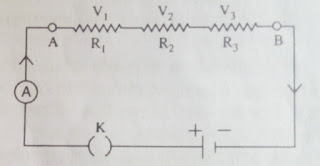
Series Grouping of Resistance


Resistor in series,series resistance, Series Grouping of Resistance
Resistor in series

R = R1 + R2 + R3


Parallel Grouping of Resistance


resistor in parallel,parallel resister, Parallel Grouping of Resistance
Resistor in parallel

R = 1/R1 + 1/R2 + 1/ R3


Conductance - किसी Conductor के प्रतिरोध के वितरण को उस चालक की Conductance कहते हैं जिसे G से सूचित करते हैं!

इसका मात्रक Mho होता है!

Resistivity - किसी चालक के पदार्थ का विशिष्ट प्रतिरोध उसी पदार्थ से बने इकाई लंबाई तथा इकाई अनुप्रस्थ परिच्छेद के क्षेत्रफल के तार का Resistance होता है !


Electric Energy (विद्युत ऊर्जा)


किसी निश्चित समय में current द्वारा द्वारा किए गए work की मात्रा , विद्युत ऊर्जा  कहलाती है ! इसका मात्रक Kilowatt-hour ( किलो वाट घंटा) है !

Electric Power (विद्युत शक्ति)

कार्य करने की दर को Power कहते हैं ! किसी विद्युत उपकरण में वे होने वाली विद्युतीय शक्ति की गणना Watt में की जाती है !

Ohm's Law (ओम का नियम)

नियत ताप पर किसी conductor के सिरों के बीच विभवांतर उसमें प्रवाहित current के अनुक्रमानुपाती होते हैं !

V= iR

Terms using in resistance -

1. Temperature coefficient of resistance
2. Volatage coefficient of resistance
3. Tolerance
4. Stability
5. Noise
6. Reliability
7. Power Rating

Varistor and Thermistor

Varistor

कई Electronics Circuit में resistance का मान स्थिर होता है यद्यपि Temperature और दूसरी भौतिक स्थितियां बदलती रहती है ! लेकिन दूसरे ऐसे भी प्रतिरोध हैं जिनका मान Temperature के अनुसार घटता बढ़ता रहता है ! जिस प्रतिरोध का मान temperature या applied voltage के अनुसार बदलता रहता है उसको Varistor कहते हैं !

Thermistor

दो प्रकार के resistance होते हैं जिनका मान temperature के अनुसार बदलता रहता है ! एक जिसमें मेटल होता है और दूसरे जिसमें semiconductor metal में positive temperature coefficient होता है ! इनका प्रतिरोध ताप बढ़ने से बढ़ता है , इसको Resistance कहते हैं यही Thermistor के नाम से जाना जाता  है !


               more>> WLAN

                                Bluetooth Technology

                                Bipolar junction transistor

                                FET

                                Flip Flop


BJT : Important Fact | Short Note - Technology Publish


BJT - Bipolar Junction Transistor          


1. It is a current controlled device

2. Low input resistance device

3. Higher power dissipation when compared to FET

4. Bipolar device

5. Current is carried by both majority and minority carrier 

6. Noisy device

7. Leakage current it is emitting therefore thermal stability is less

8. Gain is large

9. Gain bandwidth product is constant

10. Emitter is highly doped to inject its majority carrier into the base

11. Base is lightly doped to reduce the recombination in the base region

12. Bases provided with the small area to reduce the transit - time
13. Transit time is the time taken by the charge carrier in moving from emitter to collector

14. Transistor action take place in the base region

15.  Collector is moderately doped

16.  Emitter provided with medium area

17. The essential requirement of transistor designing is the emitter charge carrier must reach the collector and this is obtained by keeping the conductivity of the base much smaller than conductivity of emitter

18. Emitter is relativity highly doped when compared to base and collector

19. Base is relatively lightly doped when compared to emitter and collector

20. Transistor can work as an excellent amplifier when operated at Forward Active region

21. Transistor can work as a switch when operated at cutoff and saturation region

22. The transistor will be consuming maximum power when operated in active region


Wednesday, June 3, 2020

FET : Short Notes | Important points - Technology Publish


Field effect transistor


Field effect transistor

1. The operation of FET is controlled by electric field intensity produce in the device.

2. It is a voltage controlled device.

3. High input resistance device.

4. In most of the measuring instrument FET is connected on the input side to offer a large input resistance.

5. Unipolar device

6. Majority carrier device

7. No minority career

8. Less noise device when compared to BJT.

9. No leakage current and therefore temperature effect on the device is less or excellent thermal stability.

10. Larger bandwidth

11. Gain bandwidth product is constant 

12. Offset voltage (cut in voltage) is zero

13. Negative power dissipation


Disadvantages

1. Smaller gain
2. Small GBW product

Source-
               It is the source of majority carrier

Drain-
              It Drains of majority carrier

Gate -
              It is the terminal which control the majority carrier moving from source to drain or indirectly control the drain current

FET: Field Effect Transistor
BJT: Bipolar Junction Transistor


Read more>> WLAN

                         Bluetooth Technology

                         Bipolar junction transistor

                         FET

                         Flip Flop

                         Op-amp

                         Programming model 

                              Power amplifier

                              Capacitor

                              TRANSISTOR


Flip-flop|Electronics|Types of Flip Flops|sequential logic circuit|types of triggering


Flip Flop


It is used to store state information.
Simply put, a flip flop is a type of circuit that has two states (0 or 1).  

The flip-flop is a sequential logic circuit.Which is capable of 
storing a bit. The output of the flip flop is stable. And it carries only two values like high voltage or low voltage: - an output will be either 0 or 1.

Flip Flop is a binary storage device. This binary bit can store 0 or 1. It is the smallest storage unit of a computer such as: - It stores a single bit (0 or 1). The number of external inputs depends on the type of flip flop. Flip flop is also called stable multi-vibrator.
Generally two output lines are available in flip flops which are opposite of each other. Most people confuse flip flops and latch, flip flop and latch are both circuits and both work to store information. One difference between the flip flop and the latch is that whenever the input of the latch changes, the output also changes.
While the Flip Flop is a combination of latch and clock, it is made up of latch and clock. This puts the control operation at the clock output so the output does not change and it depends on the clock. Use the clock in a flip flop so that when the input changes, then the functionality or internal logic of the flip flop will not be affected. Operation is called triggering. triggering is required to initiate the operation. 
There are two types of triggering –
1.Edge
2.Level
Types of Flip Flops

1.   R S Flip Flop
2.   J K Flip Flop
3.   D Flip Flop
4.   T Flip Flop


1. R S Flip Flop


R-S Flip Flops are basic or fundamental Flip Flops because
all Flip Flops are generated from the R S Flip Flop itself. Where R S Flip Flop has two external inputs R (reset) and S (set). When R is active (R = 1) the output reset is Q = 0 and when S is active (S = 1) the output set is Q = 1. R-S Flip Flops are also called Bistable multivibrator. To make an R S Flip Flop, use two NAND or NOR gate.

SR Flip Flop,Flip Flop,SR,SR gate
SR Flip Flop 
SR flip flop Truth Table,SR flip flop,Truth Table
SR flip flop Truth Table

2. JK Flip Flop


JK Flip Flops meets a shortcoming of RS Flip Flop. The main disadvantage of RS Flip Flop is that when the clock is triggered, both inputs should not be high. That is, we cannot use a set (1,1) of input in RS Flip Flop. But in JK Flip Flop we can use this set of input (1,1).

JK Flip Flop,JK,Flip Flop
JK Flip Flop
JK Flip Flop using Nanad Gate,JK Flip Flop,JK
JK Flip Flop using Nanad Gate
JK Flip Flop using Nor gate,JK,JK Flip Flop,Flip Flop
JK Flip Flop using Nor gate
JK Flip Flop Truth Table,Truth Table,JK Flip Flop
JK Flip Flop Truth Table

3. D Flip Flop


D Flip Flop is used to create a delay if a delay is required inside a circuit. The same output is given as input is given in D Flip Flop such as: - If given 1 input then output will also be 1. Or if 0 input is given, the output will also be 0. D Flip Flop is also called delayed Flip Flop. This is a single input flip flip. There is also no race condition. 
D Flip Flop,Flip Flop,D
D Flip Flop
D Flip Flop Truth Table, Truth Table,D Flip Flop
D Flip Flop Truth Table

4. T Flip Flop


T Flip-Flop is a single input flip flop.This is a simpler version of JK Flip Flop. T Flip Flop is known as toggle Flip-Flop. T Flip Flop is widely used in counters, it is a sequential circuit that changes state after each clock pulse.


T Flip Flop,Flip Flop,T
T Flip Flop

T Flop Flop Truth Table,Truth Table,T Flop Flop,T
T Flop Flop Truth Table


Read more>> WLAN

                         Bluetooth Technology

                         Bipolar junction transistor

                         FET

                         Flip Flop

                        Op-amp

                        Programming model 

                            Power amplifier

                            Capacitor

                            TRANSISTOR